A saddle that continually creeps forward is one of the most common issues riders experience. It can affect rider balance, restrict the horse’s movement and, in some cases, indicate a deeper problem. While it is often blamed on girths or tack, research shows the reality is usually more complex.
The Horse’s Conformation
The horse’s natural shape plays a huge role in saddle stability.
Horses with low or flat withers and a round ribcage often struggle to hold a saddle in place. Without the natural “ridge” of the withers acting as an anchor point, the saddle has little to stop it migrating forward during movement.
Similarly, horses with a forward girth groove tend to pull the girth—and therefore the saddle—towards the shoulders. Because the girth always seeks the narrowest part of the ribcage, the saddle can gradually follow.
This is a mechanical interaction between the horse’s anatomy and the position of the girth straps rather than a simple tack issue.
Saddle Fit and Balance
A saddle that is not correctly balanced on the horse will almost always migrate.
If the saddle is too wide in the tree, the front can drop down around the withers and slide forward during motion. If it is too narrow, the tree points may perch behind the shoulder and be pushed forward with every stride.
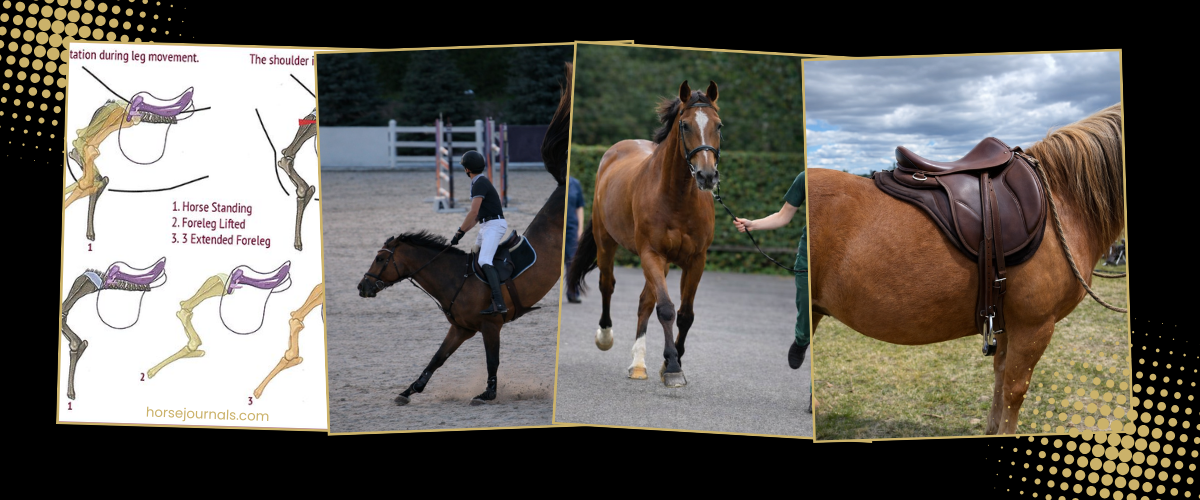
Placement also matters. Saddles positioned too far forward can interfere with the shoulder blade, which moves significantly backwards during stride. This can tilt the saddle and push it further forward with movement.
When a saddle sits in the horse’s natural balance point, it is far less likely to move.
Movement Asymmetry and Lameness
Scientific research has shown that saddle movement is strongly linked to asymmetry in the horse’s movement.
Studies analysing saddle motion found that saddle slip is frequently associated with hind-limb lameness or uneven movement patterns. In fact, research has shown saddle slip to be much more common in lame horses than sound horses.
This occurs because the horse loads one hind limb differently, creating asymmetrical forces that push the saddle in a particular direction during each stride.
Even subtle asymmetry—sometimes not obvious to the rider—can create progressive saddle movement over time.
Rider Influence
The rider also contributes to saddle stability.
Biomechanical studies show that pelvic rotation and asymmetry in the rider’s position can increase lateral saddle movement, particularly during rising trot when the saddle naturally moves slightly with each stride.
If a rider consistently collapses a hip, sits crookedly or loads one stirrup more heavily, it can gradually shift the saddle’s position.
This doesn’t mean the rider is necessarily “causing” the issue—but the interaction between horse, saddle and rider always matters.
Tack Choices
Tack can influence stability, but it is rarely the root cause.
Different girth designs, pads or accessories may improve stability, but research suggests they usually modify the symptoms rather than solve the underlying cause. Often the primary driver of saddle movement comes from the horse’s biomechanics or saddle fit rather than the girth itself.
In some situations additional equipment such as a crupper may be used to prevent forward saddle movement, particularly on horses with very low withers or when travelling downhill.
However, these should not replace correct saddle fitting.
The Takeaway
A saddle slipping forward is rarely caused by just one thing. It is usually the result of an interaction between:
• The horse’s conformation
• Saddle fit and balance
• Movement symmetry or lameness
• Rider posture
• Tack configuration
Addressing the problem effectively means looking at the whole horse–saddle–rider system, rather than focusing on a single piece of equipment.
When the saddle sits in the horse’s natural balance point and the horse is moving comfortably and symmetrically, stability usually improves dramatically.
.png)